
Why Siblings Have Different DNA
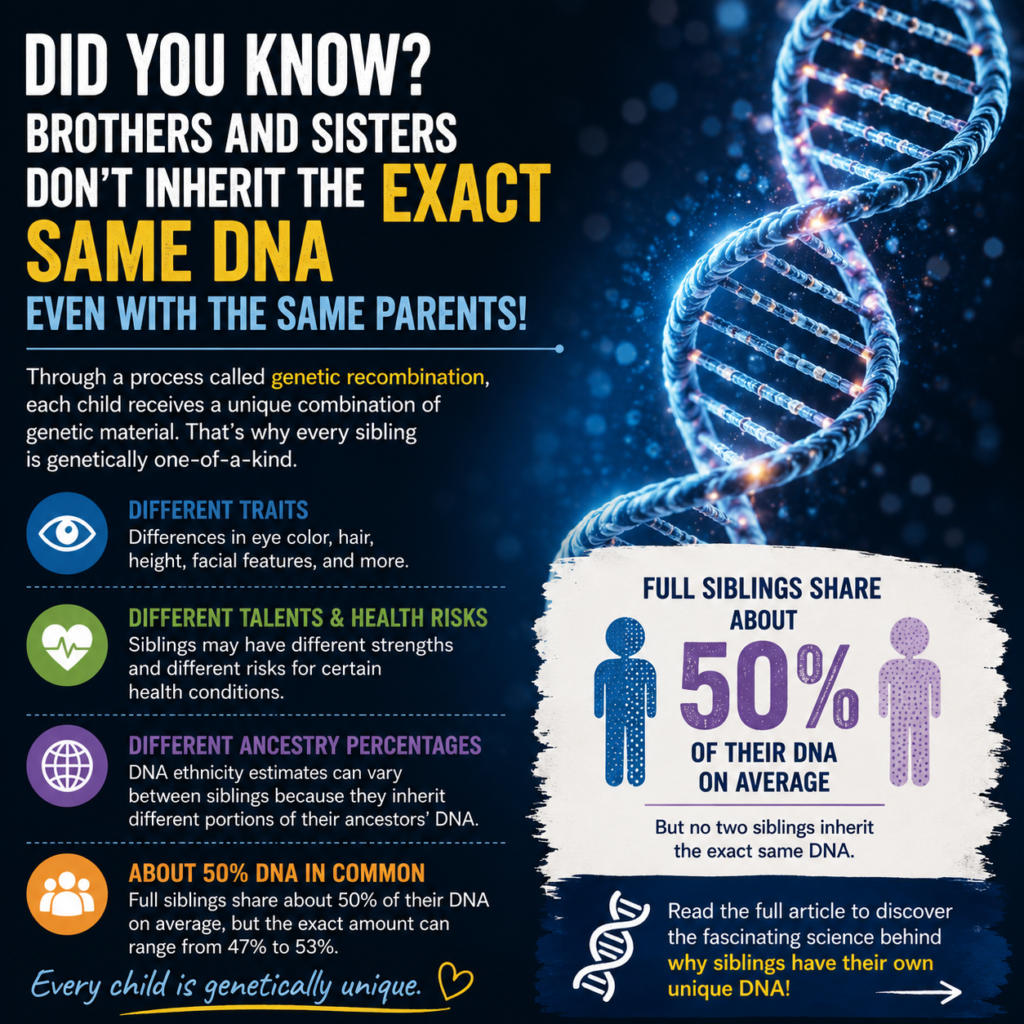
Many people are surprised to learn why siblings have different DNA even when they share the same mother and father. Although brothers and sisters inherit DNA from the same parents, each child receives a unique combination of genetic material. This process explains why siblings can look different, have different health risks, and even receive different ethnicity estimates from DNA testing companies.
Understanding why siblings have different DNA requires a closer look at genetics, inheritance, and the remarkable process that creates a one-of-a-kind genetic blueprint for every child.
Why Siblings Have Different DNA: Understanding Human DNA
Every human being carries approximately 20,000 genes organized into 23 pairs of chromosomes. Twenty-two of these pairs are known as autosomal chromosomes, while the final pair determines biological sex.
You inherit half of your DNA from your mother and half from your father. Your mother contributes 23 chromosomes through her egg cell, and your father contributes 23 chromosomes through his sperm cell. Together, these create the 46 chromosomes found in nearly every cell of your body.
At first glance, this sounds simple. If every child gets half from Mom and half from Dad, why do siblings have different DNA?
The answer lies in the incredible process of genetic recombination.
Why Siblings Have Different DNA: The Role of Genetic Recombination
Before eggs and sperm are formed, a special type of cell division called meiosis takes place. During meiosis, chromosomes exchange pieces of DNA in a process called recombination.
This means your mother’s chromosomes are shuffled before she passes them to her children. The same thing happens with your father’s chromosomes.
Instead of receiving an exact copy of one grandparent’s chromosome, a child receives a chromosome that contains pieces from multiple grandparents mixed together.
Think of it like shuffling two decks of cards. Every time the cards are shuffled, a new arrangement appears. The cards themselves have not changed, but the order is different.
Your parents’ DNA is shuffled in a similar way before it is passed to each child. This means every egg and every sperm carries a unique genetic combination.
According to the National Human Genome Research Institute (https://www.genome.gov), genetic recombination is one of the primary reasons human beings inherit unique combinations of DNA from their parents. This process helps explain why siblings have different DNA despite sharing the same mother and father.
The result is that every child receives a one-of-a-kind genetic package.
Why Siblings Have Different DNA When They Share 50% of Their DNA
On average, full siblings share approximately 50 percent of their DNA.
The phrase “on average” is important.
One sibling might share 47 percent of their DNA with a brother or sister, while another pair may share 53 percent. The exact amount varies because inheritance is random.
Imagine your mother has a recipe book with thousands of ingredients. Each child receives a different selection of those ingredients. The same thing happens with your father’s genetic contributions.
Because each child receives a different mixture from both parents, no two siblings inherit exactly the same DNA unless they are identical twins.
This randomness explains why siblings can look dramatically different from one another despite sharing the same parents.
Why Siblings Have Different DNA From Their Grandparents
Another reason siblings differ is that each child inherits DNA from grandparents in different proportions.
Although you receive approximately 25 percent of your DNA from each grandparent on average, the actual amount can vary.
One sibling may inherit more DNA from a maternal grandmother, while another may inherit more from a maternal grandfather.
This explains why one child may resemble a grandparent who passed away decades earlier while another sibling does not show those same features at all.
Genealogists often see this phenomenon in family photographs.
One sibling may strongly resemble a great-grandfather, while another seems to carry traits from a completely different branch of the family tree.
Why Siblings Can Have Different Ethnicity Estimates
Many people are surprised when their DNA ethnicity estimates differ from those of their brothers and sisters.
For example, one sibling may show a higher percentage of Irish ancestry while another shows more Scottish or German ancestry.
This does not mean the DNA test is wrong.
Instead, each sibling inherited different portions of their parents’ ancestral DNA.
Since ethnicity estimates are based on the DNA segments a person inherited, the percentages can vary among siblings.
Both results are correct because each sibling received a different genetic mixture from the same family tree.
Why Siblings Can Have Different Health Risks
Genes influence many health conditions.
Because siblings inherit different gene combinations, they may also inherit different health risks.
One sibling might inherit a genetic variant associated with heart disease, while another does not.
One child may inherit a predisposition toward diabetes, while another inherits genes that offer more protection.
This does not guarantee that a person will or will not develop a particular condition. Environment, lifestyle, nutrition, and many other factors also play important roles.
However, differences in inherited DNA help explain why siblings can experience very different health outcomes throughout life.
Identical Twins and Why Siblings Have Different DNA
Identical twins are the exception to the rule.
Identical twins begin as a single fertilized egg that later splits into two embryos. Because both embryos originate from the same fertilized egg, they start life with nearly identical DNA.
Their genetic similarity helps researchers better understand inheritance and human development. However, even identical twins are not completely identical in every way. Over time, environmental influences, aging, and epigenetic changes can create subtle genetic differences.
Another fascinating difference is their fingerprints. Although identical twins share nearly identical DNA, each develops a unique set of fingerprints before birth. This is one reason forensic investigators can distinguish between identical twins despite their genetic similarities.
To learn more, read our related article:
Why Identical Twins Have Different Fingerprints (And Why That Is Good)
Despite these small differences, identical twins remain far more genetically similar than ordinary siblings, making them an important subject in genetics, genealogy, and forensic science.
Scientists estimate that chromosome assortment alone can create millions of possible combinations in reproductive cells.
The Mathematics Behind Why Siblings Have Different DNA
When maternal and paternal DNA combine, the number of possible genetic outcomes becomes enormous. Recombination increases those possibilities even further.
The odds of two siblings inheriting exactly the same genetic combination are essentially zero.
Every child represents a unique genetic event.
More Than Just DNA
While genetics helps shape who we are, DNA is only part of the story.
Experiences, education, friendships, culture, nutrition, environment, and personal choices all influence how a person develops.
Two siblings may share parents, a home, and many life experiences, yet still become very different individuals.
Their unique DNA contributes to those differences, but it does not determine every aspect of who they will become.
Human identity is the result of both nature and nurture working together throughout life.
Conclusion: Why Siblings Have Different DNA
The answer to why siblings have different DNA comes down to inheritance, recombination, and chance.
Although brothers and sisters share the same parents, each child receives a unique combination of genetic material. This process influences appearance, ancestry estimates, health risks, and many other inherited traits.
No two siblings receive exactly the same genetic blueprint. That uniqueness is one of the most fascinating aspects of human genetics and one of the reasons DNA continues to be such a powerful tool for genealogy, family history research, and forensic science.
The next time you look at a brother or sister, remember that while you may share the same parents, you each carry your own distinctive genetic blueprint. You are connected by family, history, and shared ancestry, yet each of you represents a one-of-a-kind combination of DNA that has never existed before and will never exist again.
That uniqueness is one of the most remarkable features of human biology and helps explain why siblings have different DNA, even when they come from the same family.
